
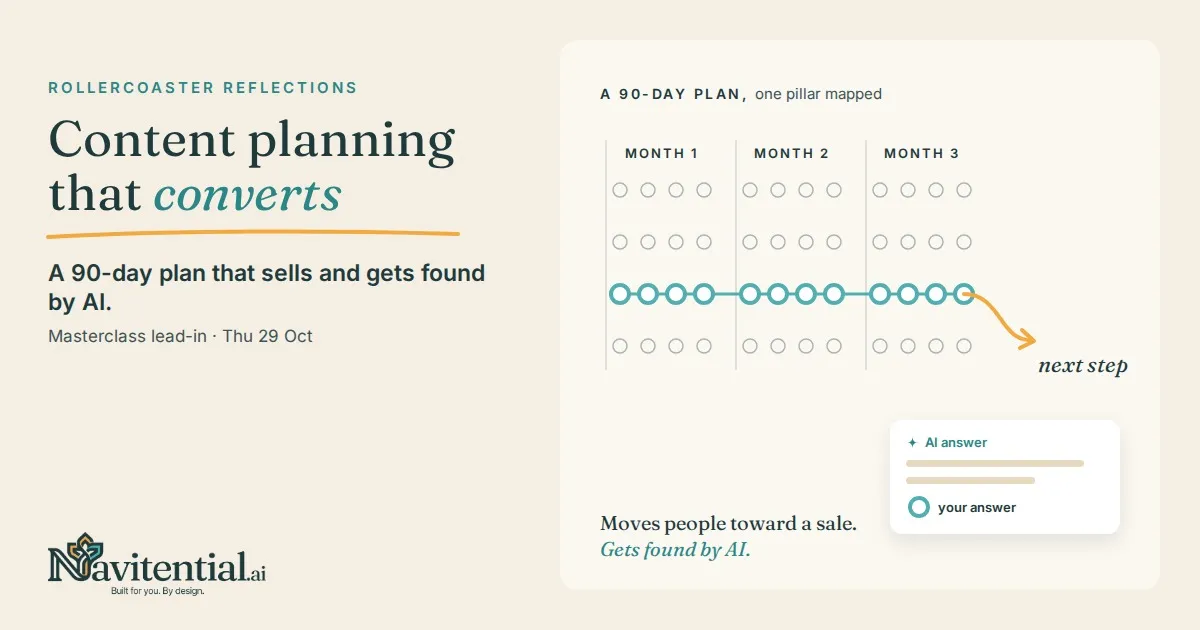
Content planning that converts: a content plan for small business that sells and gets found by AI
Most solopreneurs I talk to don't have a content problem. They have a content plan that's really a posting schedule: a list of dates, a list of topics, and a quiet hope that something in there will turn into a sale.
All through our NSW Small Business Month series, Nimmity Zappert (Authentic Selling) and I keep coming back to two things to get right before you touch any tool: a clear customer, and a clear problem you solve for them. Content is where those two things show up every week, whether you've planned it or not.
A content plan for small business now has two jobs. It has to move the right people toward buying from you. And it has to be the kind of content an AI tool picks up when someone asks a question you should be answering. Most plans do neither on purpose.
Here's how to build one that does both.
Why most content plans don't convert
A posting schedule answers "what am I putting out this week?" A plan that converts answers a different question: "what should the reader do next, and why would they?"
When every piece ends with "get in touch", or with nothing at all, you're asking content to sell without giving it a job. In my experience, that's the most common reason a solopreneur tells me content doesn't work for them. The content was fine. It just didn't point anywhere.
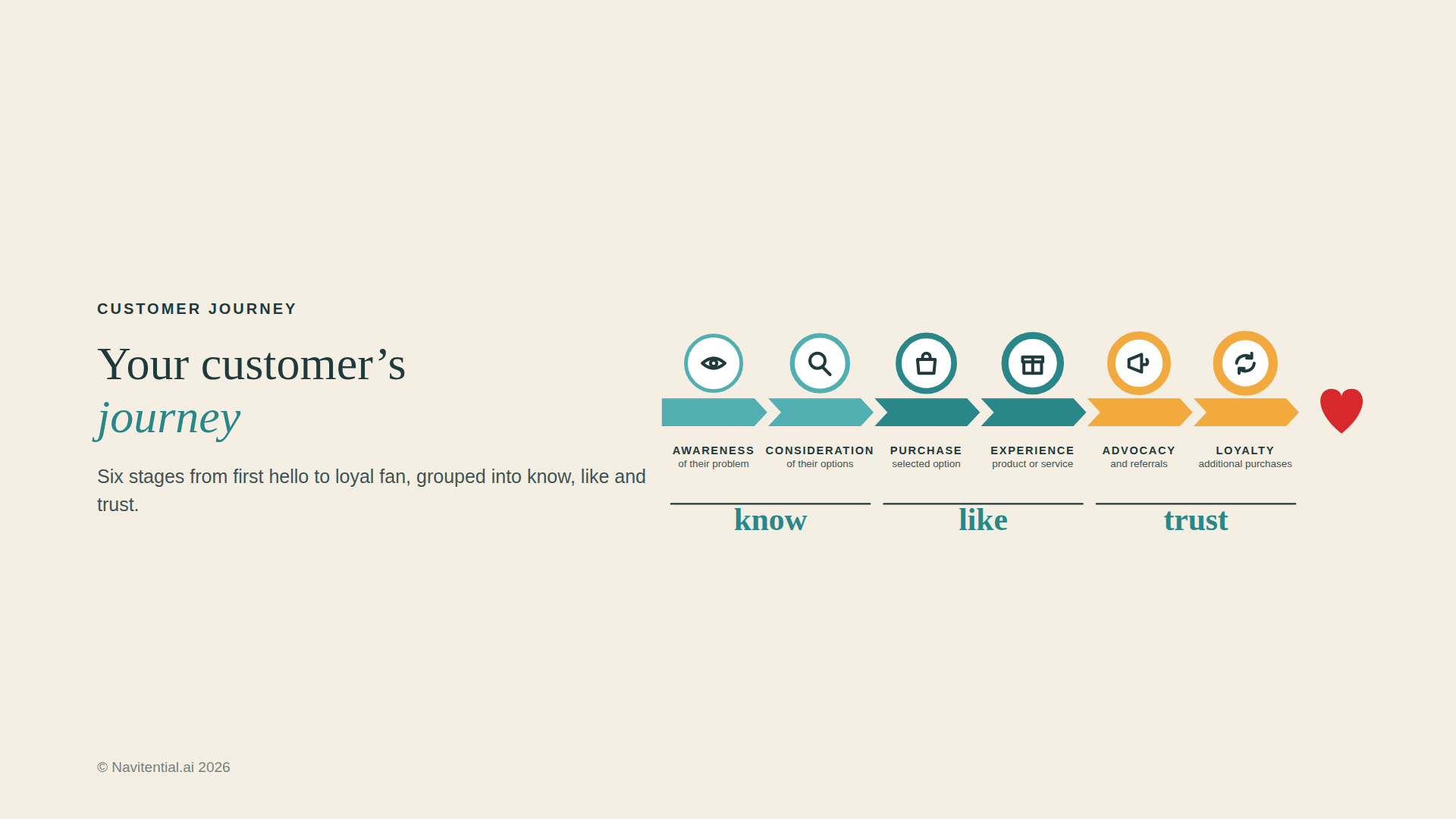
It matters more because buyers do most of the work before they ever talk to you. Green Hat's APAC B2B Buyer Research Report 2025, a survey of 632 B2B organisations across the region, found that 60% of the buying journey is over by the time the buyer engages a vendor. Your content is doing a lot of that 60% for you. Or it's leaving the job to someone else's content!
What AI Overviews changed about content planning
When Pew Research Center tracked the Google searches of 900 US adults in March 2025, people who saw an AI summary clicked a traditional search result in 8% of visits. Without a summary, they clicked in 15% of visits. Only 1% of visits with a summary ended in a click on a link inside it (Pew Research Center, July 2025).
That's US data, and Australian behaviour may differ. But the direction is clear enough to plan around. More of your reader's first answer now comes from a summary, not from your page.
Two things follow. Your content needs to be the kind those summaries draw on, so your thinking turns up in the answer. And the people who do click through are further along, so the next step you offer them had better be ready.
There's no secret format. Google's own guidance for site owners, AI features and your website, says there are no additional requirements to appear in AI Overviews or AI Mode, and no special markup to add. The foundations are the same as always: helpful, reliable content written for people. What changes is how deliberately you plan it.
The Content-to-Conversion Map: three passes over one calendar
This is the framework I'm teaching in the 29 October masterclass. It isn't a new calendar template. It's three passes over the calendar you already have (or over the gap where one should be!).
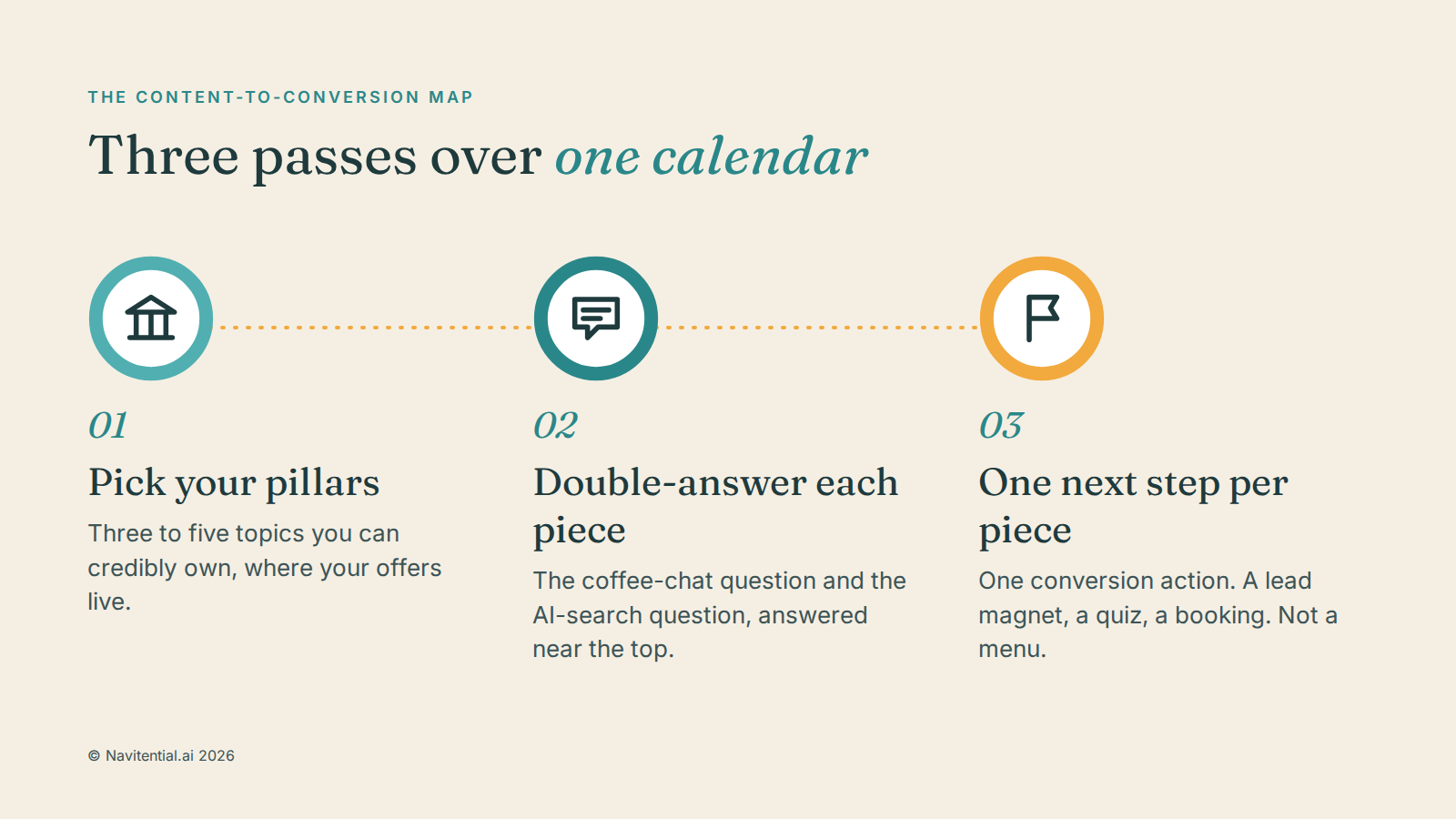
Pass 1: pick your pillars
Name the three to five topics you can credibly own. Not everything you could talk about. The topics where you've got real experience, where your clear customer's clear problem lives, and where your offers sit.
If a topic doesn't lead to anything you sell, it can still be worth writing about now and then. It just isn't a pillar.
Pass 2: double-answer each piece
Write each piece to answer two versions of the same question. The human version is how your client would say it to you over coffee. The AI-search version is how they'd type it into ChatGPT or Google, something like "How do I get my business to show up in Google AI Overviews?" rather than "AI visibility strategy".
In practice, the direct answer goes near the top, not in paragraph nine. Headings say what each section answers. And a short FAQ at the end handles the follow-up questions people actually ask. (Yes, like the one at the end of this post.)
Pass 3: one next step per piece
Every piece points at exactly one conversion action: a lead magnet, a quiz, a booking, or your current offer. One. Not a menu.
If you can't decide which step fits, that's useful information. The piece probably belongs to a different pillar, or it isn't finished yet.
What this looks like on one pillar
Say you're a business coach and one of your pillars is pricing. A posting schedule gives you "pricing post, Tuesday". The map gives you something closer to this.
The human question is "Am I charging too little?" The AI-search question is "How do I know if my coaching prices are too low?" And the one next step is a pricing quiz or calculator, because someone asking that question usually isn't ready to book a call yet.
Now the piece has a reader, a question to answer in its first paragraph, and a job. Do that for four or five pieces and the pillar starts pulling people toward the offer at the end of it, instead of just filling a Tuesday.
Where your content hands over to a conversation
Content is marketing, and marketing is one-to-many. Its job is to warm people up so that when a conversation does happen, it starts in the right place.
That means your content should answer the questions buyers ask before they call. When they book, they already know roughly what you do, how you work and whether you're a fit. Nimmity Zappert from Authentic Selling makes the same point in Where marketing and sales meet: marketing and AI can open the door, but a person needs to be there to walk your buyer through it.
Nim goes deeper on the human side this Thursday in Selling as a Human, and we bring marketing and sales together in person at the 22 October workshop in North Sydney.
Why plan 90 days, not 12 months
A year-long content calendar looks impressive in January and is usually abandoned by March (if you're lucky!). Ninety days is long enough to see whether a pillar is pulling its weight, and short enough that you'll still believe in it when you get to the end.
If your brain doesn't run in a straight line, it's also a kinder unit of planning. Plan the first month in detail, sketch the next two, and let what converted tell you what to write next. In my experience, that one review at the end of each quarter does more for results than any amount of extra posting.
Build your map with me on 29 October
Content Planning to Maximise Conversions & AI Overviews is a 90-minute masterclass on Thursday 29 October, 11:30am to 1pm AEDT, on Zoom.
You'll walk out with a content plan for the next 90 days that does two jobs at once: moves people toward a sale, and gets picked up when someone asks ChatGPT or Google's AI Overview a question you could be answering.
We'll build the map for one of your pillars together, live. The worksheet is a template, so you can repeat it for your other pillars afterwards.
It's how every monthly masterclass works: one marketing job, with an expert in the room, so you stop putting it off and start getting it done.
Tickets are $49. Navitential.ai subscribers, and active Business Booster and Business Reset clients, come free.
Book your place for 29 October →
Frequently asked questions
What is a content plan for a small business?
It's a short list of the topics you'll own, the question each piece answers, and the one next step each piece asks the reader to take, set against a publishing rhythm you can keep. The calendar of dates is part of it, not the whole thing.
How do I get my business to show up in Google AI Overviews?
Google says there's no special trick or markup. Your page needs to be indexed and eligible to appear in search, and the content needs to be helpful and reliable. Answer the question directly near the top, use headings that match how people ask, and cover the obvious follow-up questions. Nothing guarantees you'll be cited, but that's the part you control.
Do I need to write differently for ChatGPT and for Google?
Mostly, no. Clear, direct answers to real questions work for both. The difference is in the planning: you choose each piece's question with the AI-search version in mind, not only a keyword.
How much content do I need for 90 days?
Less than you think. In my experience, one solid article a week, with each piece reworked into a couple of social posts, is plenty for a solopreneur. A rhythm you keep beats a volume you can't.
Is the masterclass about Navitential?
No. It's a marketing masterclass that works whatever tools you use. You'll see my own set-up on screen as an example, and that's it.
What if I can't make it live?
Book anyway. Everyone who registers gets the replay.


