Build your own AI-powered marketing machine
Most small business owners I talk to don't have an AI marketing machine. They have an AI subscription graveyard.
A few tools signed up for in a burst of enthusiasm, each opened a handful of times. The one they tried for their marketing churned out generic rubbish, so they decided AI was a waste of time.
I get it. But the tool was never really the problem.
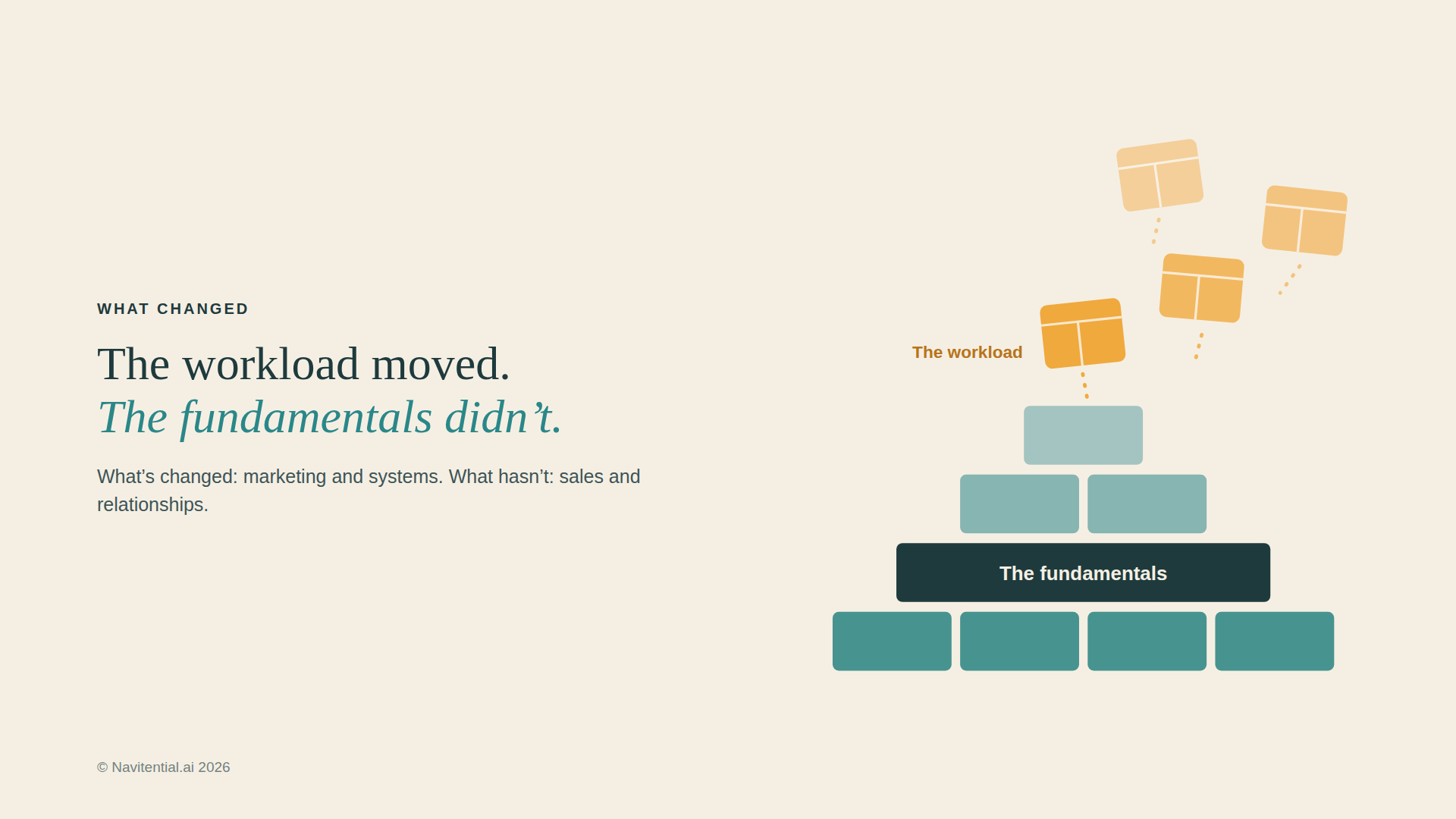
Here's the line Nimmity Zappert from Authentic Selling and I open our NSW Small Business Month series with: AI hasn't changed the fundamentals of sales and marketing. It's changed the workload.
People still buy from people they know, like and trust. What's changed is how long the marketing work takes, and how much of it you have to do by hand.
That's what a marketing machine is for.
Marketing is one-to-many, which is why it suits a machine
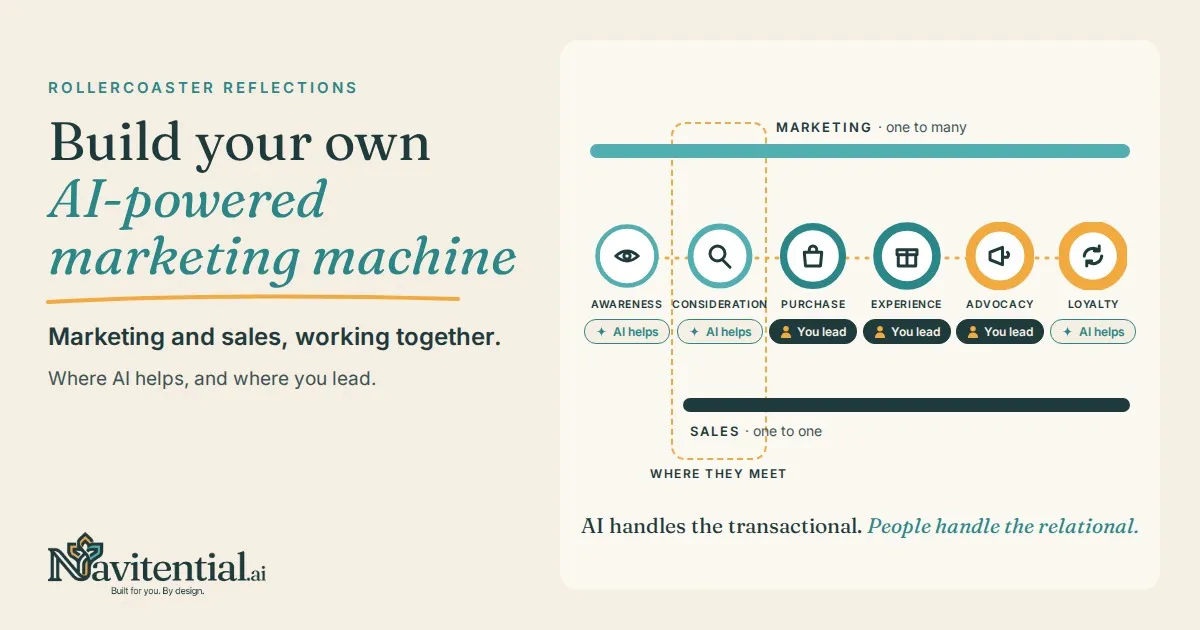
Nim has just written about where marketing and sales meet. From the sales perspective: marketing is one-to-many, sales is one-to-one, and the best businesses pass the baton back and forth the whole way through the customer's journey.
This is the marketing side of that story.
Marketing is one message reaching a lot of the right people. That makes it the part of your business where AI and automation earn their keep. Sales is a conversation. Marketing starts a conversation at scale using a system, and you can build a system.
What a marketing machine actually is
A machine has an input, a process and an output you can point to. A subscription graveyard has a login you vaguely remember, a free trial that quietly turned into a paid plan, and a nagging feeling you're "supposed" to be using AI more than you are.
At the heart of the machine is your website. Everything else connects to it: your CRM, emails and automations, bookings, payments, reporting, and the AI tools doing the drafting. Around the outside sit the channels that bring people in, like socials, search and AI results, networking, PR and events, podcasts, articles and advertising.
The number of pieces isn't the point. What matters is whether each one does a defined job that feeds the next step, or sits on its own because someone on LinkedIn said you needed it.
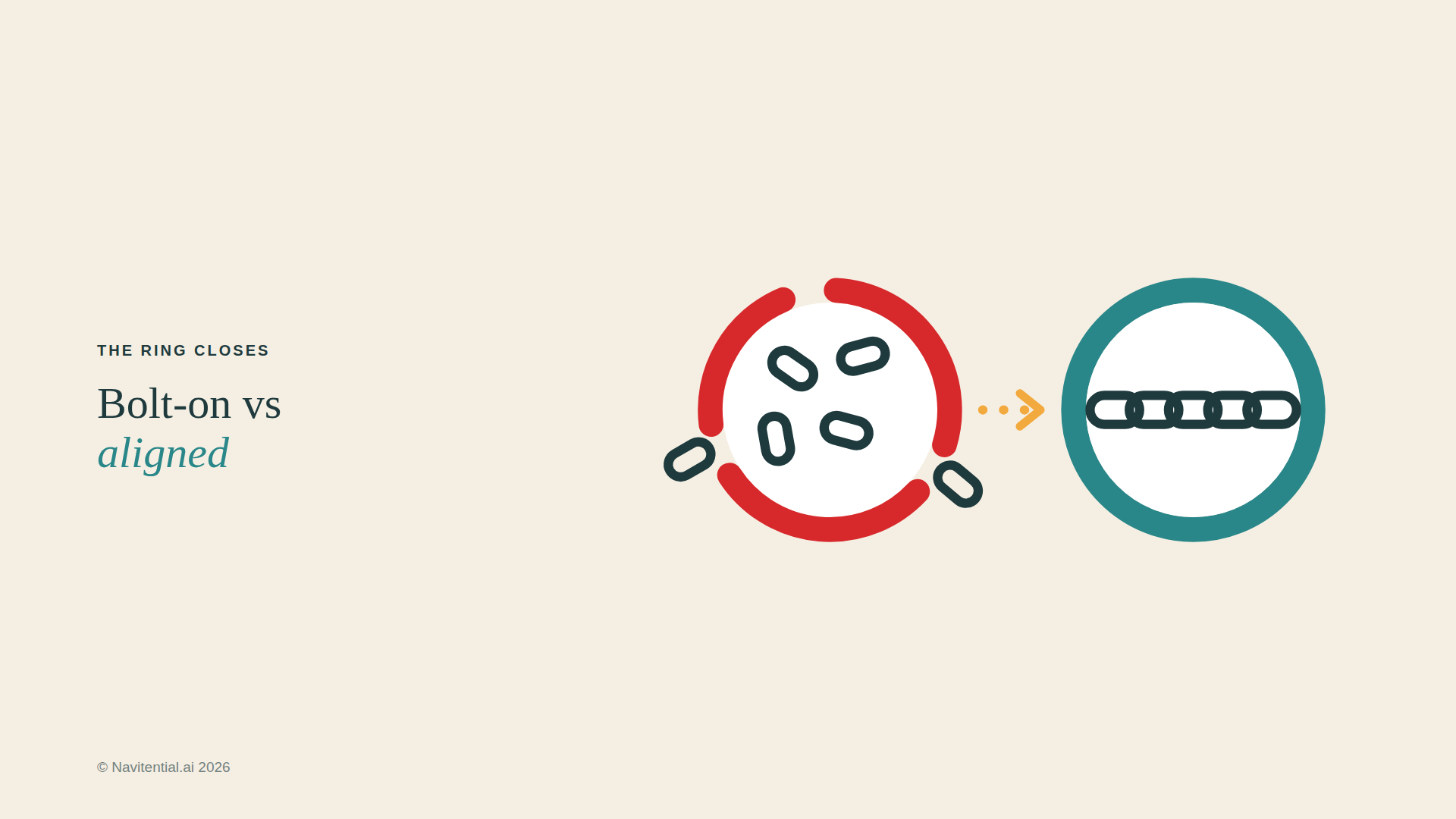
Adoption isn't the issue either. The National AI Centre's SME AI Pulse survey (December 2025 to February 2026) found 43 to 44% of Australian SMEs are using some form of AI. Among businesses using or planning to use it, content generation and data analytics were the top uses, at 54% each. In my experience, most of that use is scattered. Plenty of AI, not much machine.
Where the machine helps, and where you lead
I map marketing to a six-stage customer journey: awareness, consideration, purchase, experience, advocacy and loyalty.
Awareness: the machine does the heavy lifting. The job here is helping the right people recognise their problem, and making sure they come across you while they're thinking about it.
Consideration: the machine carries the follow-up, until it shouldn't. Someone downloads your guide or comes to your webinar. For a smaller, simpler sale, a well-built nurture sequence and a clear way to buy may be all they need. For a bigger B2B decision, the machine's job changes: flag that lead and get it to a person. That handover is where most leads leak.
Purchase and experience: you lead, the machine backs you up. Bookings, payments, invoices and onboarding emails run in the background, so the human part gets your full attention. Marketing's job is to build the tools that help the sale along: the case study that answers a common objection, or the one-pager a buyer forwards to their boss.
Advocacy: you ask, the machine captures. Referrals are personal, so the ask comes from you. What the machine can do is remind you to ask, then turn the answer into a testimonial or case study that goes back to the top of the funnel for the next person.
Loyalty: the machine keeps you front of mind. Newsletters, event invitations, a nudge when a good client has gone quiet. The conversation that follows is still yours.
Nimmity and I landed on the same pattern from opposite ends of the funnel: AI handles the transactional. People handle the relational.
Five jobs worth giving your machine
If you're building this properly, you're assigning five jobs, not buying fifteen tools.
First drafts. Posts, emails and articles, written as close to your voice as AI can get. You bring the angle and the final edit.
Distribution. Your content goes out on the right channel at the right time, without you posting manually at 9.13pm because you forgot.
Capture and follow-up. Someone fills in a form or books a call. What happens in the next five minutes, automatically, before you've even seen the notification?
Research and prep. A summary of a market, a competitor or a prospect before you meet them.
Reporting. Plain-English summaries of what your numbers are telling you, in one place, without exporting 23 spreadsheets and squinting at them on a Sunday.
Plus one human checkpoint
This is the non-negotiable. Nothing goes out in your name without a human read. You check it for accuracy, and you check it sounds like you, before anyone else sees it.
It's tempting to skip when the output "seems fine". It is fine, right up until the week it isn't and something off-brand or plain wrong goes out under your name. You become very diligent about checking after that happens, believe me!
What the machine can't do for you
You may have noticed strategy isn't on that list. Neither is positioning. That's deliberate.
Before you touch a single AI tool, get two things right: a clear customer, and a clear problem you solve for them. AI can't work those out for you. It can only amplify them. Give it nothing specific to aim at and you get beige content, fast.
AI can write pretty well in your voice once you've defined it. It can't define it for you. It can analyse your numbers. It can't tell you which number matters to your business this month.
Build it in the right order
The order you build in matters more than the tools you pick.
Start with capture. If a lead falls through the cracks, nothing you automate downstream will save it. Drafting comes next, because it's the job that eats your evenings. Reporting goes last, on purpose: there's no point measuring a machine you haven't built.
Picture a solo bookkeeper. She writes next week's social posts from scratch on Sunday night. She forgot to follow up the two people who asked about her pricing last month. She only looks at her numbers when the quarterly BAS is due.
None of that is a technology problem. It's a human-being-the-bottleneck problem.
With capture in place, those two enquiries get a same-day reply instead of sinking to the bottom of her inbox. With drafting, she edits a first pass on Monday instead of writing from scratch on Sunday night. With reporting, she sees her enquiry-to-client conversion every day, week or month, not just every quarter.
And she doesn't need a technical background for any of it. She needs to decide, once, which of the five jobs nobody in her business is doing, and build those first. When most solo operators list them out, it's usually at least three or four.
Where we work through this
This is the ground Nimmity and I cover in more detail in Sales & Marketing in the Age of AI, the first of four sessions we're co-hosting for NSW Small Business Month. Nimmity brings the sales side from Authentic Selling.
Thu 1 Oct, online: Sales & Marketing in the Age of AI. What's changed, what's noise, and where to put your energy first. 11:30am to 12:30pm AEST.
Thu 8 Oct, online: Marketing at Machine Speed. The marketing machine in action, with live demos. 11:30am AEDT.
Thu 15 Oct, online: Selling as a Human. Nim on the human side of selling. 11:30am AEDT.
Thu 22 Oct, in person at ACU Co-Lab, North Sydney: Sales & Marketing Funnels in the Age of AI. Bringing it all together. 11am.
Webinar tickets are $10 ($7 for members), or $50 ($40 for members) for the four-event bundle.
Register for Thursday 1 October →
Or book all four with the bundle →
Frequently asked questions
Do I need to replace my current tools to do this properly?
No. Most small businesses already have two or three of the five jobs covered without realising it. It's more often about connecting what you've got than buying something new.
What if I don't really have a marketing funnel yet?
Then this is more useful, not less. You get to build the jobs in the right order from the start instead of untangling them later.
How is this different from using ChatGPT for everything?
A chat window can draft content. It can't capture leads, start a nurture sequence or report on what's working. The machine connects drafting, distribution, capture and reporting, rather than asking one tool to do all of it badly.